Federal Reserve Maintains Interest Rates Amid Bitcoin Market Uncertainty
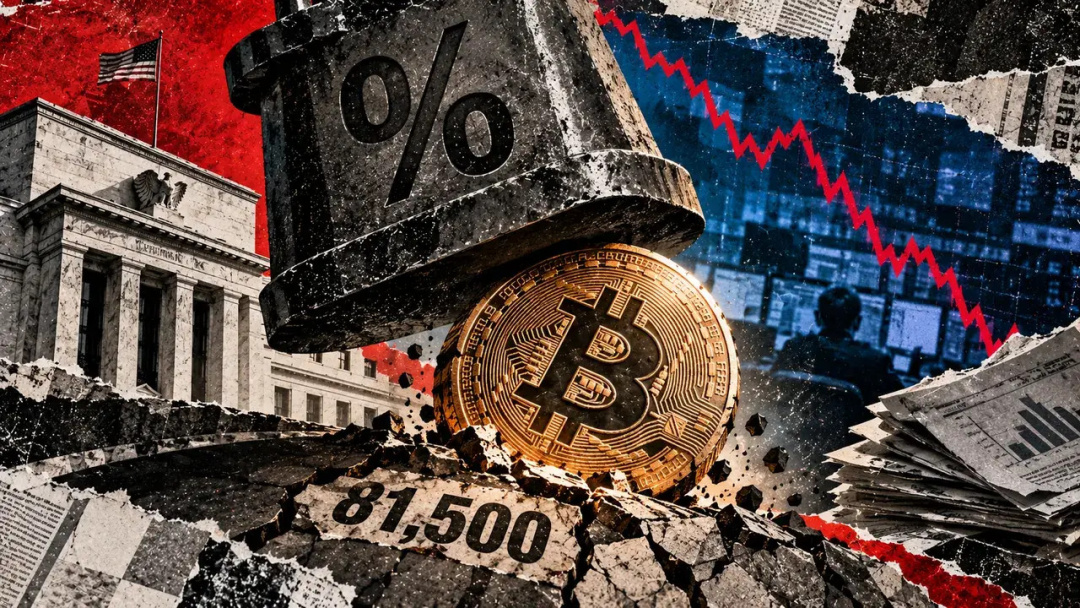
The Federal Reserve held its target interest rate range at 3.75% to 4% on October 28, resulting in a 10-2 vote. Dissenting opinions came from Governor Lisa Cook and Cleveland Fed President Beth Hammack, who favored an immediate quarter-point increase. Market trackers suggest that the likelihood of a rate hike in December is between 83% and 88%, with the market having anticipated a hold prior to the meeting.
In the wake of the Fed's decision, Bitcoin experienced a dip to $80,500 but managed to recover above $81,000, approaching the estimated $81,500 aggregate cost basis of U.S. spot Bitcoin ETFs, according to Glassnode. The Fed's committee characterized economic growth as strong and reiterated its commitment to achieving a 2% inflation target.
Market Reading & Resources
Sponsor funding complete. Trade on.
During the press conference, Chair Kevin Warsh acknowledged the tightening of credit conditions and the widening of credit spreads, noting that higher interest rates are impacting technology investments, including those in artificial intelligence. He refrained from labeling overall financial conditions as tight, indicating a willingness from the Fed to endure more market strain before altering its course.
As of the decision day, the 10-year Treasury yield was near 5.04%, while the two-year yield was approximately 4.78%. The University of Michigan's final sentiment index for October stood at 48. Fabian Dori, chief investment officer at Sygnum Bank, remarked that the market had anticipated a hawkish hold, with no changes for October and a 25 basis point hike for December already priced in. The upcoming PCE data, set to be released shortly after the Fed's decision, is expected to play a crucial role in validating the Fed's decisions.
Dori also highlighted the significance of earnings reports from major tech companies, which could clarify whether capital spending in AI is translating into revenue. He mentioned that a resolution regarding the Strait of Hormuz situation post-midterms could potentially alleviate oil prices, inflation, and rate expectations.
Glassnode's report from October 28 indicated that long-term holders control approximately 4 million BTC acquired between $85,000 and $118,000, which could represent potential supply as prices recover. These coins are distinct from sell orders, as holders may choose to sell only when they reach breakeven. About 4.3% of the supply last moved between $84,000 and $85,000, largely attributed to a single internal wallet transfer.
Since the decline on October 24, Binance bids at $80,000 totaled around $3.4 million, with the largest cluster between $78,000 and $79,000 amounting to about $42 million, an increase from roughly $24 million in mid-October. The True Market Mean is near $77,900, while the short-term holder cost basis is around $75,800. Matt Mena, senior crypto research strategist at 21shares, identified $80,000 as a critical support level, with a break potentially exposing $77,000 to $78,000 and possibly $75,800.
Reclaiming the $81,000-$82,000 range, where the 50-day moving average and ETF cost basis converge, could pave the way for Bitcoin to reach $84,000-$85,000, followed by targets of $87,000-$87,500. Softer inflation, declining yields, and a pause in December could drive Bitcoin towards $90,000 and beyond. The next significant target is between $94,000 and $95,000, which is historically important for on-chain valuation.
Market Dynamics Reflect Profit-Taking and Accumulation Trends
On October 22, on-chain data revealed about $3.7 billion in realized profit and $1.4 billion in realized loss, with the spike primarily attributed to wallet transfers. Entity-adjusted profit-taking averaged around $260 million daily, roughly half of its peak in September. The largest daily net realized loss around October 24 was about $27 million, compared to approximately $630 million at the August low, with wallets holding 100 to 1,000 BTC being the most consistent accumulators in October.
The 30-day realized volatility is currently near 25%, a level below about 95% of readings since 2015, indicating a market where sellers are becoming reluctant and buyers are returning slowly. Farside Investors reported negative net flows of $487.2 million for spot Bitcoin ETFs between October 22 and October 27.
A simplified model suggests December could either maintain the current rate or implement a 25 basis point hike. With an 87% probability, about 21.75 basis points of the hike are already factored into expectations. A drop to 50% would eliminate approximately 9.25 basis points, while a rise to 95% would add about 2 basis points. The broader market impact may stem from revisions to the 2027 rate path, which will be updated in December projections.
Brendan Ma, head of investment strategy at the Arbitrum Foundation, interpreted the hold with two dissents as keeping December options open, with most of it already priced in. He noted that tokenized stocks have risen about 12% over the past month, while tokenized Treasuries have decreased, despite the 10-year yield being near 5%. Dori's data indicates that the distributed value of tokenized stocks has increased by approximately 17.8% over the last 30 days.
If the upcoming PCE, GDP, and November payroll data indicate softer inflation expectations, yields may ease, and ETF inflows could resume, providing Bitcoin with a pathway through $81,500 and sustained closes above $85,000. The next resistance levels are between $87,000 and $87,500, where overhead supply is substantial. The 30-day volatility at 25% suggests a one-standard-deviation range of approximately $74,100 to $87,900 through December 9 from $81,000.
Inflation's Role in Shaping Bitcoin's Future Outlook
Conversely, if inflation exceeds expectations, Treasury yields may rise, and ETF withdrawals could recommence, leading to a close below the $78,000 to $79,000 bid area and the $77,900 True Market Mean, putting $75,800 in sight. A decline would carry more significance if entity-adjusted realized losses began to expand while redemptions continued.
Bitcoin's selling pressure has remained subdued, while buying activity has been limited. The forthcoming PCE, jobs, and CPI readings will be critical in determining which side prevails as the December 8-9 meeting approaches.