GENIUS Act May Expose Digital Dollars to Blockchain Network Vulnerabilities
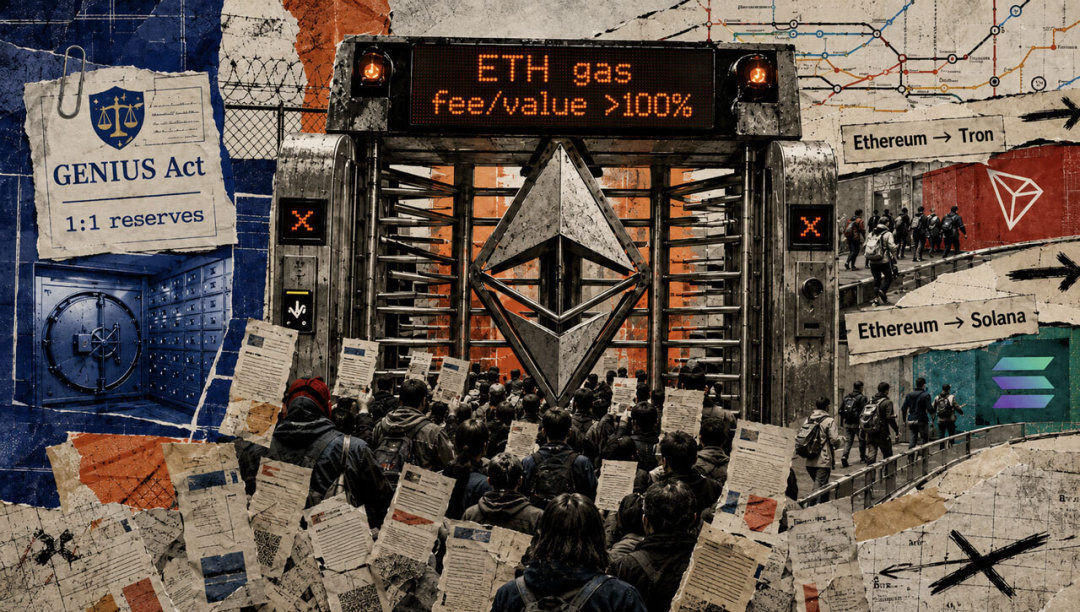
The Guiding and Establishing National Innovation for U.S. Stablecoins Act, known as the GENIUS Act, introduces a federal framework designed to enhance the safety of payment stablecoin issuers. The act's reserve rules are intended to ensure that each token represents a secure dollar claim, while the public blockchains facilitating these transactions maintain their own fee structures and capacity limitations.
A staff paper from the Federal Reserve, initially dated June 2, 2026, and updated on August 31, 2026, examines how transaction congestion can destabilize even a well-backed digital dollar. Authored by Federal Reserve economists, the paper carries a disclaimer noting that the views expressed do not necessarily reflect those of the Federal Reserve Board or the Federal Reserve System.
Market Reading & Resources
Sponsor funding complete. Trade on.
The analysis indicates that when transaction fees rise significantly, small payments may become impractical, diminishing the utility of a token. The model suggests that weak payment-network effects can lead to individual holders exiting the system, resulting in coordinated redemptions. In this context, 'redemption' refers to a decrease in Ethereum circulation, which may involve cashing out to fiat or migrating to another blockchain.
Importantly, the paper does not predict an imminent run but rather highlights a latent mechanism that could become problematic as the Treasury implements the GENIUS Act. This law grants regulators extensive authority to oversee issuers, reserves, and redemption processes, yet it does not establish specific price or capacity standards for public blockchains.
Traditional analyses of stablecoins typically focus on the issuer's assets. If a token promises a dollar but its reserves lose value or cannot be liquidated quickly, holders may rush to redeem their tokens. However, the Fed economists intentionally excluded this issue from their model, focusing instead on the interplay between transaction fees and network effects. The value of a payment asset is partly derived from its acceptance and use by others.
Under conditions of low congestion, the network can absorb shocks. Conversely, high congestion coupled with weak network effects can create a threshold beyond which redemptions may become sudden and coordinated. Increased fees lead to reduced usage, making the token less appealing, which in turn incentivizes more holders to exit.
The term 'redemption' requires careful interpretation. In the paper's empirical analysis, it is measured as a negative change in Ethereum circulation, which can indicate either a cash-out to fiat or a shift to another blockchain. Therefore, the data reflects pressure on Ethereum-based circulation rather than a straightforward count of customers redeeming tokens.
The study employs a theoretical model alongside various empirical tests, each addressing different aspects of the issue without collapsing into a single causal claim. Notably, gas fees were statistically insignificant in the weekly panel, with a reported effect appearing only when high fees interacted with weak network effects, a condition observed in approximately 7% to 7.5% of cases.
The paper also explores the impact of empty Ethereum blocks, which are likely unrelated to stablecoin demand but can reduce capacity and increase gas fees. This design helps establish that capacity shocks can elevate fees, although it does not directly confirm that such shocks caused every subsequent redemption.
The matched-transfer analysis links transfers of identical USDT amounts on Ethereum and Tron within a 60-minute window, suggesting a potential chain switch. However, this method cannot identify the beneficial owner behind each transfer or establish the motive for each movement.
Together, these findings offer a conditional warning rather than a definitive forecast: congestion can create incentives for exit, and historical data indicates that some activity has shifted towards cheaper alternatives when Ethereum fees have risen.
The GENIUS Act mandates that permitted payment stablecoin issuers maintain reserves at least one-to-one in specified liquid assets. It also requires public redemption procedures, disclosure of issuer fees, monthly reporting, and regulatory standards covering capital, liquidity, diversification, operations, and technology.
These regulations address critical failure modes, including weak assets, opaque redemption promises, undercapitalized issuers, and inadequate operational controls. They also provide regulators with a clearer framework for supervising the entities responsible for creating dollar tokens.
The Treasury's implementation proposal, published on August 18, focuses on restrictions regarding the offering or selling of payment stablecoins in the United States, with comments due by October 19. The expected effective date for the issuer licensing framework is January 18, 2027, while broader restrictions for digital asset service providers are anticipated by July 18, 2028.
The proposed rule differentiates between direct transfers between individuals and compensated services such as exchanges and custodians, which may qualify as digital asset service providers. This distinction affects compliance responsibilities.
The economic dynamics of a congested base layer persist across these categories. A reserve can remain liquid while users face transaction fees that exceed the intended payment amount. The nuances of issuer fees and blockchain gas fees are distinct, and the current proposal leaves base-layer pricing and capacity outside its explicit stablecoin regulations.
As a result, two safety tests are in effect simultaneously. Supervisors can evaluate whether an issuer can fulfill its dollar claim and manage operations, while users must determine whether the network can support that claim at a reasonable cost during periods of stress.
Stablecoins are already distributed across various networks with differing fee structures. A recent snapshot indicated stablecoin supply at approximately $147.3 billion on Ethereum, $93.2 billion on Tron, and $15.7 billion on Solana. The snapshot showed Ethereum fees were relatively low, while costs on other chains are structured differently.
A direct dollar-price comparison among these networks can be misleading due to their varying fee systems. The essential comparison lies in the structural differences of 'stablecoin fees' across different networks and transaction conditions.
The immediate impact of congestion is felt by transactions with the least value to absorb fixed network charges. A small self-custody user may delay payments, combine transfers, switch to an exchange, or cease using the chain altogether. This response can occur even if the token remains redeemable at par.
Larger intermediaries, such as exchanges and market makers, are more likely to influence chain-level circulation or restore liquidity where users wish to transact. This inference is based on market operations rather than direct findings from the Fed paper.
Destination chains may experience both activity and pressure from these shifts. A surge in transactions can enhance stablecoin liquidity while testing the routes and intermediaries that rebalance inventory. These second-order effects are analytical inferences rather than direct findings from the paper's data.
The policy implications extend beyond whether an issuer holds sufficient Treasury bills; users also require a reasonably priced route to access their redeemable dollar claims during periods of network stress.
The snapshot from September 3 indicates that Ethereum fees were stable at the time, but it does not measure overall redemption pressure. The paper reframes the rail-safety gap as a monitorable risk rather than evidence of an imminent crisis. Regulators and market participants can observe fee-to-transfer-value ratios, abrupt changes in stablecoin circulation, matched cross-chain flows, and exchange wallet imbalances.
While the GENIUS Act can enhance the safety of stablecoins, it does not guarantee that every access route to these tokens will be resilient. If the implementation prioritizes reserve quality as the sole measure of safety, future stress events may reveal that while the dollar token itself is sound, access to it may not be reliable.