Bitcoin's Market Dynamics Tested by Fed Chair Kevin Warsh's Inflation Insights
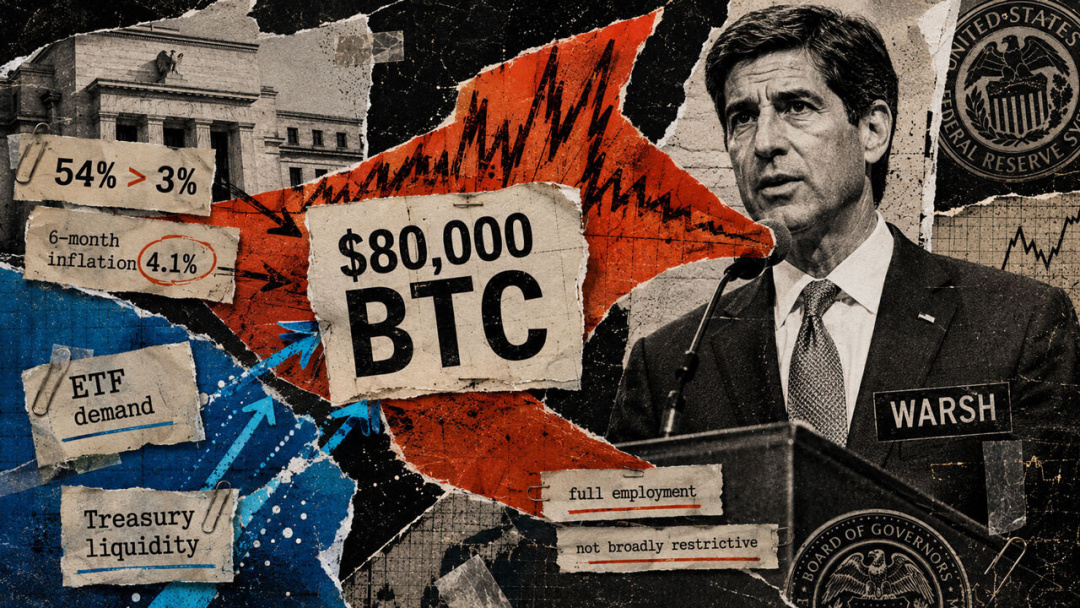
Bitcoin is currently navigating a critical macroeconomic landscape as Federal Reserve Chair Kevin Warsh emphasizes the ongoing challenges posed by inflation. In his recent speech at Jackson Hole, Warsh pointed out that 54% of the components in the personal consumption expenditures (PCE) index have increased at a rate exceeding 3% over the past year. This statistic serves as a new benchmark for assessing Bitcoin's market performance, particularly as it attempts to recover the $80,000 threshold.
Following Warsh's remarks, Bitcoin experienced fluctuations, dipping below $80,000 after reaching a peak of $81,280. Market data indicated that Bitcoin remained around the $79,000 mark, reflecting traders' reactions to the inflation metrics presented. Warsh's insights provide a clearer framework for evaluating the risks associated with Bitcoin's rebound, particularly in light of the current economic conditions.
Market Reading & Resources
Sponsor funding complete. Trade on.
In recent sessions, US-traded spot Bitcoin exchange-traded funds (ETFs) have seen significant inflows, totaling over $1.1 billion through August 27. Concurrently, the Treasury is preparing to implement larger liquidity-support buybacks starting September 9, aimed at stabilizing market conditions. However, these measures are primarily focused on debt management rather than directly addressing inflation.
Warsh's analysis revealed that while the breadth of inflation has improved from a post-pandemic high of nearly 77%, it remains elevated compared to the pre-pandemic average of 32%. He noted that 49% of PCE components have also exceeded a 3% annualized rate over the past six months, indicating persistent inflationary pressures. This data complicates the Federal Reserve's ability to pivot towards a more accommodative monetary policy, as the firm target for PCE inflation remains at 2%.
The current financial landscape presents a dual challenge for Bitcoin. On one hand, the demand for Bitcoin through ETFs has been robust, with significant inflows recorded over several days. On the other hand, the competitive nature of cash and short-dated government debt increases as the market anticipates a sustained higher policy path. This dynamic places additional pressure on Bitcoin, which does not yield interest, making it less attractive in a tightening monetary environment.
The concentration of ETF inflows, particularly from BlackRock's iShares Bitcoin Trust, raises questions about the durability of this demand. While the inflows have provided temporary support for Bitcoin's price, the reliance on a single product for a substantial portion of demand could expose the market to volatility if allocations shift.
As Bitcoin continues to navigate these economic challenges, three key factors will determine its resilience: the continuation of ETF inflows post-speech, the diversification of demand beyond major players like BlackRock, and the ability to reclaim the $80,000 price level. Success in these areas would suggest a more sustainable recovery for Bitcoin, while failure could indicate that recent price movements are merely a temporary cushion against broader market pressures.
In the context of rising Treasury yields, particularly the two-year yield which reflects near-term policy expectations, Bitcoin's market dynamics are closely tied to inflation data and Federal Reserve policy decisions. The Treasury's upcoming liquidity-support buybacks are intended to enhance trading conditions in the bond market, indirectly influencing risk appetite across financial assets, including Bitcoin.
Overall, Bitcoin's current market position is precarious, with inflation metrics and Federal Reserve policy shaping its trajectory. The interplay between ETF demand and broader economic indicators will be critical in determining whether Bitcoin can sustain its recent gains or if it will face further challenges ahead.