Fed Study Links Bitcoin Gains to More Crypto Purchases by U.S. Households
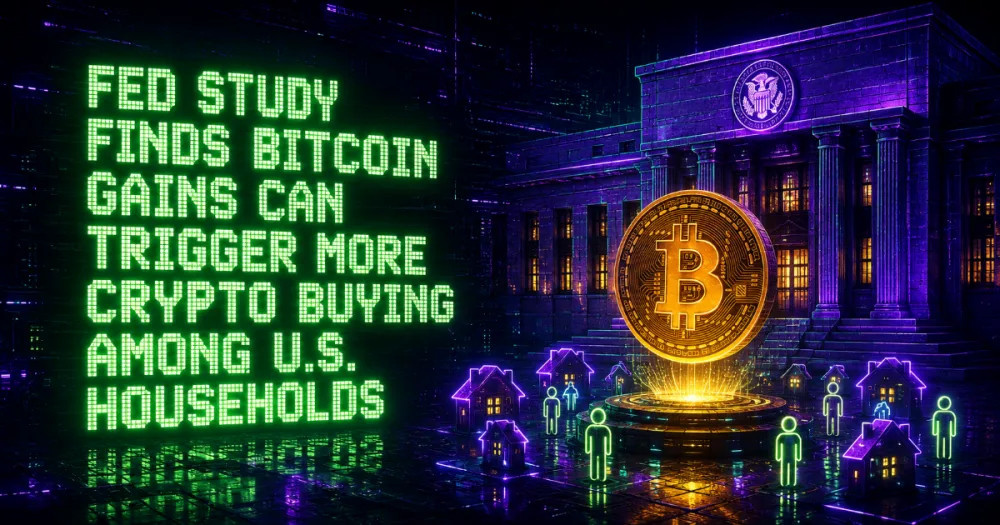
A working paper from the Federal Reserve Bank of Cleveland has highlighted the relationship between Bitcoin gains and the purchasing behavior of U.S. households regarding cryptocurrency. The study, published on July 14, 2026, was conducted by economists Michael Weber, Bernardo Candia, Olivier Coibion, and Yuriy Gorodnichenko. It utilized data from multiple household surveys and a randomized information experiment involving 15,000 to 25,000 participants in the second quarter of 2025.
The findings indicate that households exposed to Bitcoin's trailing 12-month returns increased their target cryptocurrency allocation by two percentage points, which represents a 47% increase compared to the control group's average allocation of 4.3%. Furthermore, those who received information about Bitcoin were 2.5 percentage points more likely to purchase cryptocurrency in subsequent survey waves.
Market Reading & Resources
Sponsor funding complete. Trade on.
In 2021, Bitcoin owners anticipated an average return of 22% over the following year, while non-owners expected a lower return of 7%. By 2025, these expectations had decreased, with owners expecting 13.8% and non-owners anticipating 4.7%. The study also found that expected returns were closely correlated with cryptocurrency ownership; each percentage point increase in expected return raised the likelihood of holding cryptocurrency by 0.8 percentage points.
The randomized experiment provided participants with information about Bitcoin, the S&P 500, GameStop, or inflation. Those receiving Bitcoin-related information, which included details about its 14.3% return from the previous year or a price chart, showed increased desired allocations for both cryptocurrency and stocks, often at the expense of cash and savings accounts.
The results suggest that past Bitcoin returns may create a feedback loop, attracting more investors and potentially leading to a bubble-like effect. However, the authors caution against assuming that all periods of rising Bitcoin prices will lead to sustained increases in value.
Additionally, the paper examined how Bitcoin gains might influence household consumption of durable goods, such as computers and refrigerators, but found minimal impact on non-durable goods consumption.
It is important to note that this research is preliminary, and the views expressed in the paper do not necessarily reflect those of the Cleveland Fed or the Federal Reserve System.