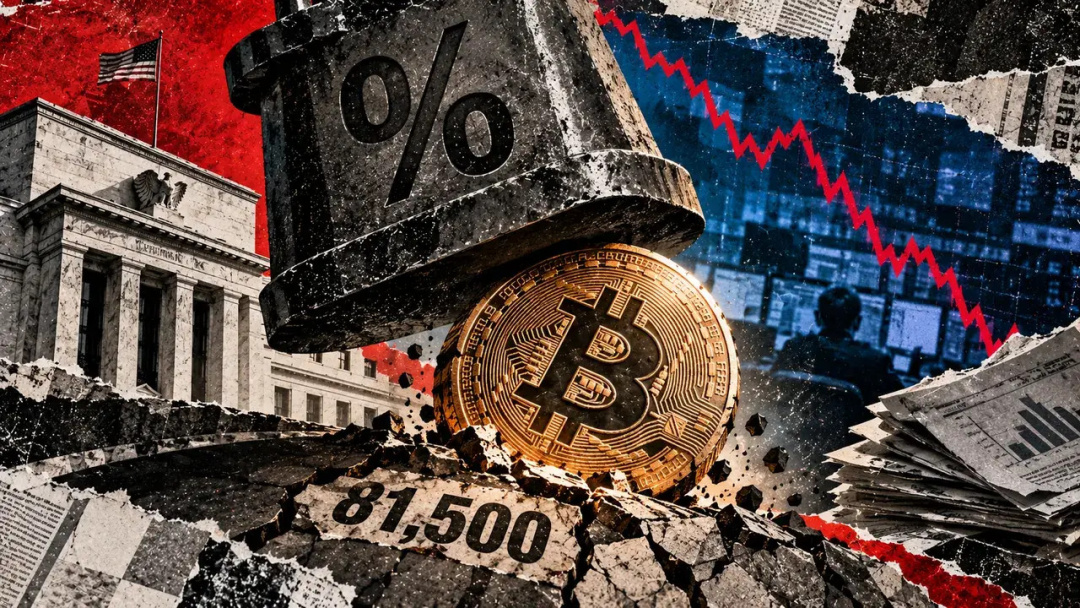
Fed Officials Vote for Rate Hike as Bitcoin Struggles at $62,000

The Federal Reserve recently decided to keep its benchmark interest rate steady at 3.50% to 3.75%, a decision that was not without contention, as three officials—Beth Hammack, Neel Kashkari, and Lorie Logan—voted for a quarter-point increase. This marked the first time since September 2016 that three members dissented in the same direction. Following the announcement, Bitcoin briefly rose above $64,000 before settling back to around $63,600, indicating its precarious position near a critical price range identified by on-chain analytics firm Glassnode.
Glassnode highlights the $62,000 to $68,000 range as significant, representing a cost-basis cluster for Bitcoin's supply profile. This range is split between long-term holders, who typically provide market support, and short-term holders, who may be more inclined to sell if prices fluctuate. A move above $69,000 could convert that resistance into support, potentially paving the way for Bitcoin to challenge the next major supply wall between $83,000 and $86,000.
Market Reading & Resources
Sponsor funding complete. Trade on.
Market dynamics have shifted, with three-month Bitcoin futures yielding less than two-year Treasury yields since February, which has diminished the incentive for institutional trading desks to engage actively in crypto markets. Spot trading volumes have also dropped to their lowest levels since 2019, with exchange activity nearing a three-year low. Recent data from Farside Investors indicated a significant outflow of funds, with approximately $999 million entering the market from July 14 to 22, followed by $526 million exiting over four consecutive days.
Investment strategist Can-Luca Köymen from Sygnum Bank noted that the Fed's stance suggests a prolonged restrictive macroeconomic environment. He remains cautiously optimistic, contingent on manageable inflation levels, oil prices, and ongoing on-chain accumulation. Conversely, Iggy Ioppe, chief investment officer at Theo, expressed skepticism about immediate catalysts for market movement, suggesting that focus may remain on yield generation rather than directional exposure to Bitcoin.
The upcoming PCE report, scheduled for July 30, along with employment data and CPI figures in early August, will be critical in shaping market sentiment ahead of the Fed's next meeting in mid-September. June's CPI report indicated a slight easing in inflation, with a 0.4% month-over-month decline in headline inflation, primarily driven by a 5.7% drop in energy prices.
However, rising oil prices, which settled 7.91% higher at $90.74 on July 29 due to renewed Middle East tensions, could complicate the inflation outlook. Analysts predict that Brent crude may fluctuate between $80 and $100 in the near term. In a favorable scenario, manageable inflation data and a retreat in oil prices could lead to renewed ETF inflows and a breakout for Bitcoin above $69,000.
On the other hand, if oil prices remain high and inflation exceeds expectations, traders may anticipate a more aggressive rate hike in September, putting pressure on Bitcoin. A drop below $62,000 could exacerbate selling pressure among short-term holders, risking a deeper market correction.
As the market navigates these challenges, Bitcoin's next significant movement will depend on whether macroeconomic conditions improve enough to attract new buyers. Until then, the asset remains under pressure, with Treasuries currently offering better yields than Bitcoin's carry trade, and the $62,000 to $68,000 price shelf holding steady without resolution.