Pakistan Requests $10 Billion from US Amid Economic Crisis
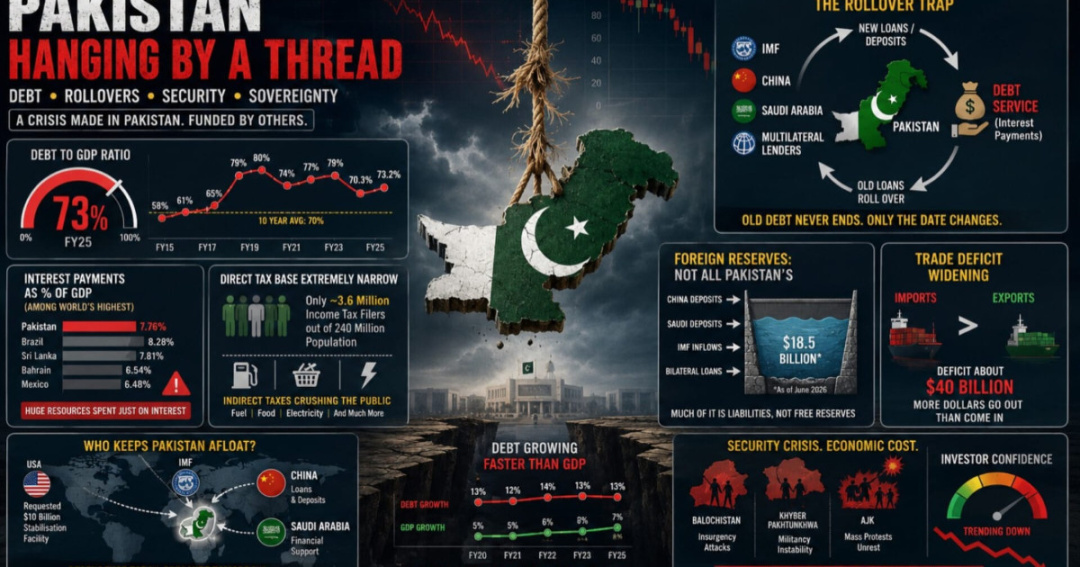
Pakistan is currently navigating a severe economic crisis that extends beyond inflation and debt, evolving into a geopolitical challenge. The government is reportedly seeking a $10 billion currency stabilization facility from the United States, a move that follows its recent efforts to position itself as a diplomatic mediator in the Iran-Israel conflict. However, these diplomatic initiatives have not resulted in significant breakthroughs, leading to speculation that Pakistan's foreign policy is increasingly driven by economic necessity rather than strategic foresight.
The request for financial assistance underscores a troubling reality: Pakistan's economy is becoming increasingly reliant on external powers to maintain macroeconomic stability. Public debt has surged to approximately 73% of GDP, a significant increase from around 58% a decade ago. This rising debt is outpacing economic growth, with interest payments consuming a substantial portion of GDP, thereby limiting fiscal resources for essential sectors such as healthcare, education, and infrastructure.
Market Reading & Resources
Sponsor funding complete. Trade on.
Rather than reducing its debt burden, Pakistan has resorted to rolling over existing obligations, relying on financial support from Saudi Arabia, the International Monetary Fund (IMF), and commercial creditors. This cycle of refinancing has led to a situation where old debts are replaced with new ones, creating a precarious financial environment. Although foreign exchange reserves have improved since the 2023 crisis, much of this recovery is attributed to external deposits and official financing rather than genuine export growth. The country continues to import significantly more than it exports, with its export base heavily concentrated in textiles and other low-value sectors.
Without structural reforms, this unsustainable cycle is likely to worsen. Pakistan's financial difficulties are compounded by a deteriorating internal security situation, with rising militant attacks in regions such as Balochistan and Khyber Pakhtunkhwa. Political instability, particularly the ongoing unrest in Pakistan-administered Kashmir, adds another layer of uncertainty, further eroding investor confidence. The interplay between economic stability and national security is becoming increasingly evident, as prolonged instability raises financing costs and deters foreign direct investment.
The reported request for a $10 billion stabilization facility from the US marks a significant shift in Pakistan's geopolitical strategy. Historically, Islamabad has relied on financial support from Beijing, Riyadh, and the IMF. However, the current situation suggests that Washington may now be viewed as a critical financial partner. Despite attempts to leverage diplomatic goodwill from its role in the Iran crisis, Pakistan's efforts have so far yielded limited financial assistance.
In a concerning development, unverified reports from Pakistani intelligence sources indicate that Saudi Arabia has declined to support an $8 billion financing arrangement sought by Islamabad, complicating its search for external liquidity. If true, this would represent a notable departure from Riyadh's traditional role as a key financial ally. Additionally, there are claims that Pakistan's defense commitments to Saudi Arabia could require military support in the event of conflict in Yemen, which would place Islamabad in a precarious regional position.
As Pakistan's fiscal vulnerabilities deepen, there is growing concern that external financial dependence may lead to increased leverage over its strategic decision-making. While there is currently no evidence to suggest an imminent threat to Pakistan's nuclear capabilities, heavy reliance on foreign creditors often results in diminished policy flexibility. The political landscape remains polarized, with former Prime Minister Imran Khan imprisoned and his supporters arguing that economic reform is contingent upon political stability.
Pakistan is not on the brink of collapse, but its economic model is increasingly fragile, relying on a precarious balance of external support and domestic productivity. The central question is not merely whether Pakistan requires another bailout, but whether it can continue to rely on repeated bailouts without addressing the structural weaknesses that have led to its current predicament. As long as economic survival hinges more on diplomatic negotiations than on domestic economic growth, Pakistan's sovereignty will remain at risk, constrained by the geopolitical expectations tied to financial assistance. The delicate thread holding Pakistan's economy together has not yet broken, but it is thinner than it has been in decades.