AI Agents Transform Prediction Markets Ahead of Fed Rate Decision
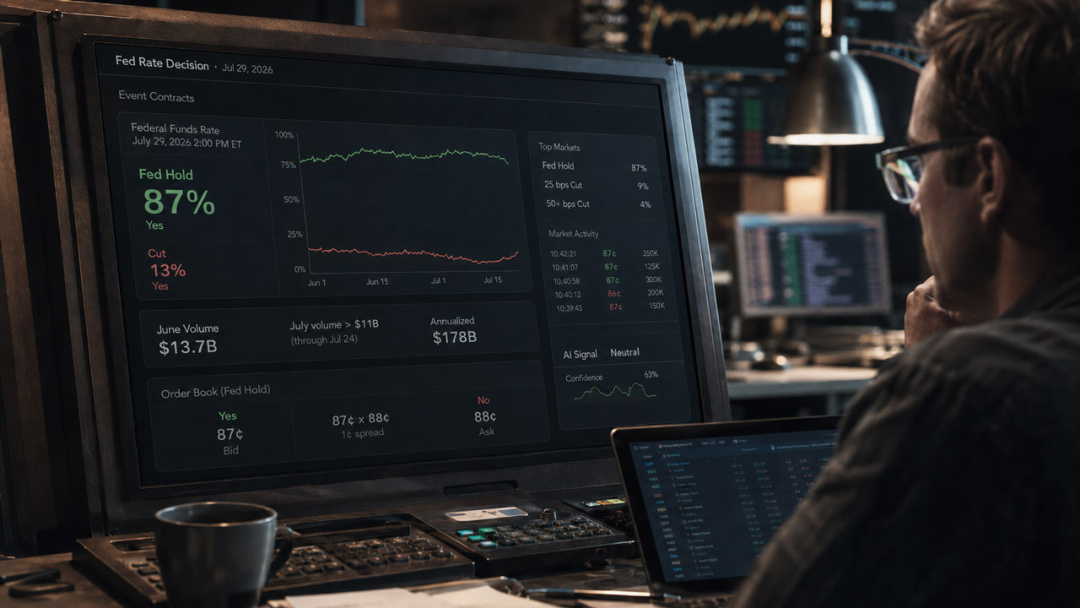
The Federal Reserve's upcoming meeting on July 28 and 29 is prompting traders to engage with various financial instruments, including bonds, currencies, cryptocurrencies, and contracts that directly reflect the central bank's decisions. A recent Reuters poll of 104 economists indicated a unanimous expectation for the Fed to maintain interest rates between 3.50% and 3.75%. Kalshi's July contracts reflect this sentiment, with an 87% probability assigned to this outcome and approximately $29.7 million in trading volume.
Market makers, quantitative firms, and AI agents are now part of the trading landscape, continuously monitoring prices and adjusting probabilities. This shift is attracting institutional interest, as firms begin to utilize event contracts to identify traders—both human and algorithmic—capable of pricing uncertainty more effectively than the market average. The combined monthly trading volume for Kalshi and Polymarket reached a peak of $13.7 billion in June, with July already surpassing $11 billion, indicating a growing professional scale in prediction markets.
Market Reading & Resources
Sponsor funding complete. Trade on.
Kalshi reported a remarkable tripling of its annualized volume over six months to $178 billion, alongside an 800% increase in institutional trading volume. The firm has also executed its first customized block trade. Key players like Clear Street, Marex, and Jump Trading are enhancing access to these markets, with Clear Street connecting institutional clients to Kalshi, Marex bridging both Kalshi and Polymarket, and Jump facilitating direct access to event markets for institutions.
Corporate treasuries are also exploring these contracts to hedge against tariff and regulatory risks, which necessitates a reliable counterparty willing to continuously price trades. The development of a functional market relies on a supply side that can quote both directions and swiftly correct any pricing discrepancies.
Louis Régis, founder of the on-chain prop firm Propr, emphasizes that event contracts demand a higher level of trader selection compared to traditional markets. The structured nature of these contracts allows for clearer evaluation of a trader's ability to price probabilities accurately. The Foresight Arena benchmark suggests that establishing a genuine edge in pricing requires a substantial number of resolved predictions.
Propr is planning to extend its evaluation model to Polymarket, enabling traders and AI agents to qualify for accounts up to $100,000 and manage up to $300,000 across multiple accounts, with an 80% profit share for those who meet performance criteria. Currently, Propr allocates about 5% of its trading signals to live venues, with the remainder held internally to gather sufficient data before deploying capital.
Régis anticipates that AI agents will thrive in prediction markets due to their structured environment and the ability to continuously reprice contracts. A recent study involving six AI models trading autonomously on Kalshi and Polymarket revealed that these models experienced capital losses, highlighting the challenges of translating predictive accuracy into profitable trades.
In an optimistic scenario, increased participation from funded traders and market makers could enhance liquidity and tighten spreads, potentially leading to more accurate price discovery across platforms. Conversely, there is a risk that the competitive edge may concentrate among a few firms with superior infrastructure, leaving casual traders at a disadvantage.
As the Fed's decision approaches, the market is already pricing in expectations, with the real competition occurring in the probabilities that lie outside the consensus. Upcoming economic data releases, including the GDP estimate on July 30 and the employment report on August 7, will further challenge traders to accurately price surprises and adjust their strategies accordingly. Success in these markets hinges on the ability to consistently price events correctly, a skill that could attract backing from funded trading firms.