Investors Navigate Volatility in AI Stock Market
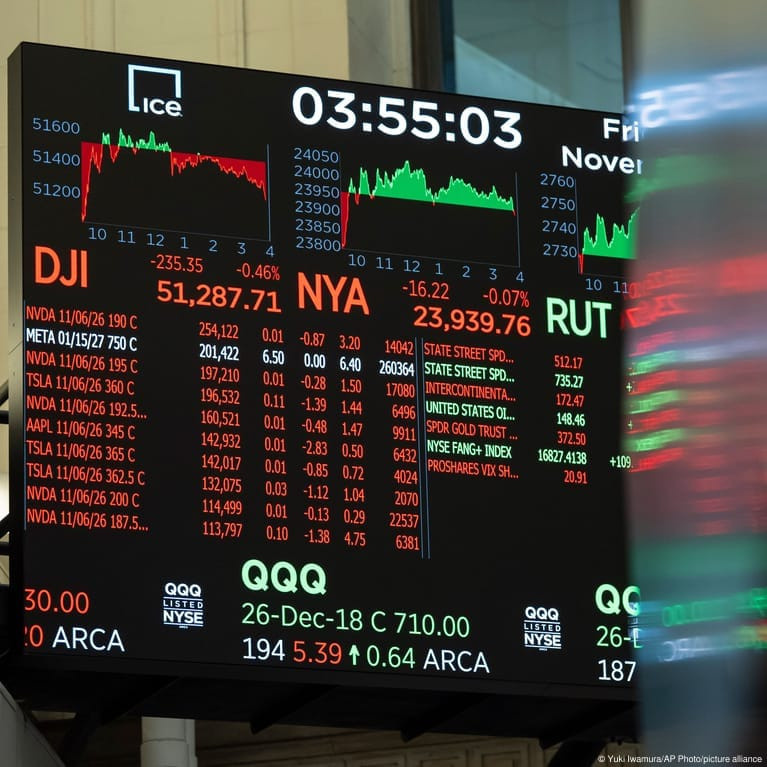
The Nasdaq stock index has experienced a significant rebound this week, recovering from a recent sell-off that impacted technology and artificial intelligence (AI) stocks. Following its worst week since the pandemic crash in March 2020, the index opened on Monday nearly 1,700 points, or 7%, higher. This surge was partly fueled by Nvidia's stock, which rose over 30% after the reinstatement of CEO Jensen Huang, who had recently resigned amid a scandal involving extramarital affairs.
Despite this recovery, the volatility in the AI and tech sectors has left even seasoned investors feeling uneasy. Many are seeking to diversify their portfolios, but options are limited as the US stock market has been at the forefront of the AI hype. Economists point out that index funds, which manage the pensions and savings of millions of passive investors, are increasingly exposed to the AI boom. These funds tend to buy stocks based on market capitalization, meaning that as companies like Nvidia, Microsoft, and Apple grow, they occupy a larger share of these funds.
Market Reading & Resources
Sponsor funding complete. Trade on.
The MSCI All Country World Index (ACWI), which includes over 2,400 firms across developed and emerging markets, is heavily weighted towards US tech giants. Nine of its top ten holdings are US companies, with TSMC, a Taiwanese chipmaker, being the only exception. This concentration raises concerns about the resilience of a portfolio that is overly reliant on a single country's performance.
Gerd Kommer, founder of Gerd Kommer Invest, emphasizes the importance of diversification across various sectors and countries. He warns that a portfolio heavily concentrated in US tech stocks does not adequately represent the global economy. Investors looking to reduce their exposure to AI-related stocks may need to consider developed market funds outside the US, which have historically offered lower returns.
Risks of Passive Investing in AI Stocks
Dimitri Vayanos, a finance professor at the London School of Economics, highlights the risks associated with passive investing in a market dominated by a few large firms. He notes that when investors become overly optimistic about a company, it can lead to inflated stock prices, which index funds exacerbate by automatically purchasing more shares. This creates a cycle where prices continue to rise, making it riskier for professional investors who attempt to short these stocks.
Potential Risks Ahead
As the AI sector continues to attract significant investment, the potential for a market correction looms. If the AI bubble bursts, it could have severe repercussions for the global stock market, particularly for tech and AI stocks. Retail investors, who often invest heavily in these sectors through ETFs, may face substantial losses. While some experts argue that holding an ETF is safer than individual stocks, the rapid influx of capital into passive funds raises concerns about the sustainability of current valuations.
The recent rebound in AI stocks may not be sustainable, and history suggests that bubbles eventually burst. Investors should remain cautious and consider the implications of their portfolio allocations. As the market evolves, those heavily invested in tech and AI may find themselves vulnerable to significant downturns. The ongoing volatility serves as a reminder of the risks associated with concentrated investments in a rapidly changing landscape.