Asian Markets Rise Following Wall Street Rally Amid Slowing US Inflation
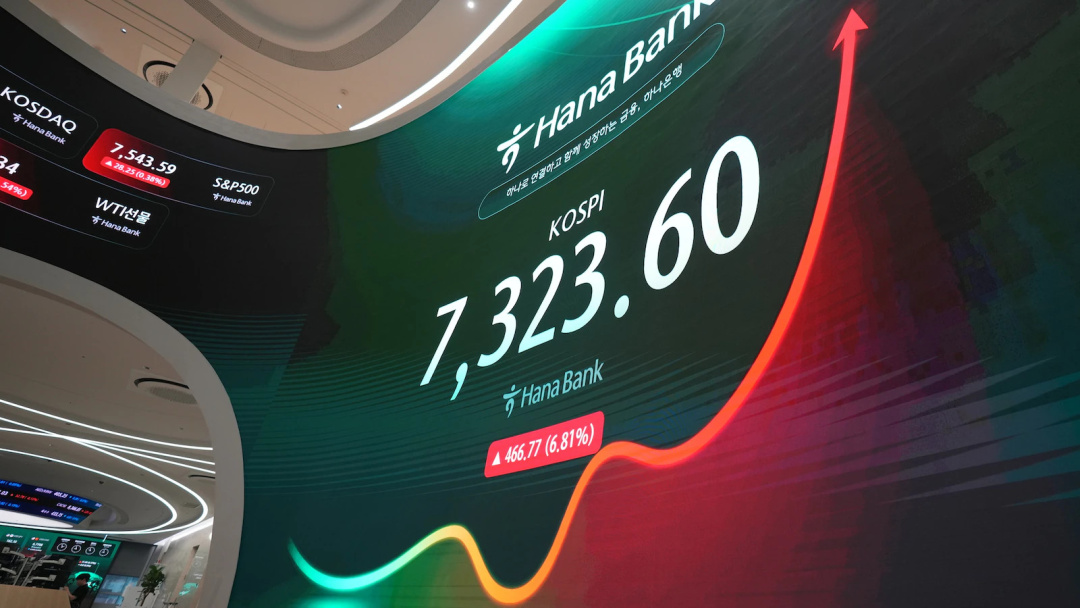
Asian markets showed mostly positive trends on Wednesday, following a rally on Wall Street spurred by a report indicating that U.S. inflation was not as severe as economists had predicted. South Korea's Kospi surged by 7.1% to reach 7,343.37, rebounding from a recent downturn in semiconductor stocks. Japan's Nikkei 225 rose 0.9% to 68,353.91, while Australia's S&P/ASX 200 increased by 0.2% to 8,830.00. In contrast, Hong Kong's Hang Seng index edged up 1.6% to 24,721.10, but the Shanghai Composite fell 0.4% to 3,952.04.
The Chinese economy reported a 4.3% annualized growth rate for the April to June period, a decline from the 5% growth seen in the first quarter. Despite the overall gains in stock prices, concerns about escalating tensions between the United States and Iran have raised worries about potential disruptions in oil and gas transport through the Strait of Hormuz. This geopolitical uncertainty has contributed to rising oil prices, with benchmark U.S. crude increasing by 86 cents to $80.20 a barrel and Brent crude gaining $1.15 to $85.88 a barrel.
Market Reading & Resources
Sponsor funding complete. Trade on.
Tim Waterer, chief market analyst at KCM Trade, noted that the recent military exchanges between the U.S. and Iran have complicated the situation in the Strait of Hormuz, leading to a decline in shipping traffic in the Gulf. On Wall Street, the S&P 500 added 0.4%, recovering some of its previous day's losses, while the Dow Jones Industrial Average saw a slight increase of less than 0.1%. The Nasdaq composite climbed 0.9%, aided by a rebound in major tech stocks such as Micron Technology and Nvidia.
The easing of yields in the bond market also contributed to market stability, with the yield on the 10-year Treasury dropping to 4.58%. This decline followed a report indicating that U.S. consumers faced a 3.5% increase in living costs compared to the previous year. Lower inflation figures may reduce pressure on the Federal Reserve to raise interest rates, which could have broader implications for economic growth and investment prices. Following the inflation report, traders assessed the likelihood of a rate hike at the Fed's upcoming meeting to be less than 17%. In currency markets, the U.S. dollar slightly decreased against the Japanese yen and the euro, reflecting ongoing adjustments in response to economic data.